New national resource explains handicap placard laws, qualification rules, renewals, travel use, and application requirements in all 50 states.
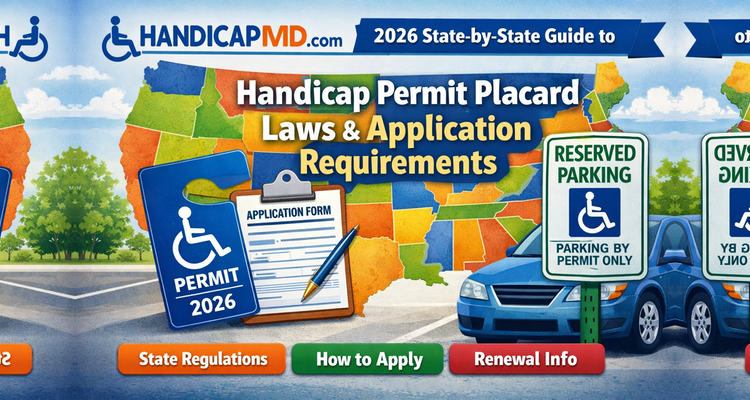
LOS ANGELES, CA, UNITED STATES, March 25, 2026 /EINPresswire.com/ — HandicapMD has launched a new national resource, State-by-State Guide to Handicap Permit Placard Laws and Application Requirements, designed to help patients, caregivers, and families understand how handicap permit placard laws, disabled parking permit laws, and state-by-state handicap placard rules differ across the United States. The new guide brings together information on qualification standards, medical certification requirements, permit types, interstate recognition, renewals, misuse penalties, and state-specific application pathways in one comprehensive destination. According to the live page, the guide covers all 50 states plus Washington, D.C., and is positioned as a broad educational hub for users seeking answers about handicap parking permit laws, DMV disability placard rules, and how to apply for a handicap placard.
The launch reflects a growing need for clear public education around accessible parking. Many applicants know they may need a disabled parking placard or handicap parking permit, but they are often unsure about who can sign the form, whether temporary conditions qualify, how long a permit lasts, whether out-of-state placards are honored, or what rules apply when parking at meters, in loading zones, or while traveling. HandicapMD’s new guide addresses those questions directly by explaining both the national legal framework and the state-level differences that affect real applicants every day. The page specifically notes that every state honors out-of-state placards, but meter rules, exemptions, and time limits can vary significantly by jurisdiction.
At the center of the new resource is an effort to simplify what is often a fragmented process. While federal accessibility rules shape how accessible parking spaces must be created and maintained, each state still determines its own handicap placard application requirements, medical certification rules, renewal timelines, placard designs, and enforcement procedures. That split between federal structure and state administration is one of the biggest reasons people become confused when applying for a disability parking permit or using one across state lines. HandicapMD’s guide helps bridge that gap by explaining the ADA’s role, clarifying what federal law does and does not control, and then breaking down how state rules fit into the bigger picture.
The guide also emphasizes that eligibility for a handicap placard or disabled parking permit is generally based on functional limitation, not simply on whether a person has a diagnosis. The live page explains that qualifying categories may include an inability to walk approximately 200 feet without stopping to rest, the use of an assistive device such as a cane, crutch, walker, brace, or wheelchair, severe lung disease, portable oxygen use, cardiac disease with major functional limitation, or neurologic, orthopedic, or arthritic conditions that materially restrict safe ambulation. That distinction matters because many people search for who qualifies for a handicap parking permit without realizing that the legal and medical standard often turns on mobility, endurance, breathing limitation, or safety rather than the name of a condition alone.
Another major focus of the new page is the difference between permit types. HandicapMD explains that most states issue permanent disability placards, temporary disability placards, and in many cases additional credentials such as disabled license plates, organizational placards, and certain veteran-related disability parking credentials. The guide notes that permanent placards are generally intended for chronic or long-term conditions and that validity can range from two to six years depending on state law. It also explains that temporary disability placards are commonly used for short-term mobility impairment, including recovery after orthopedic surgery, severe fractures, acute medical limitations, or certain pregnancy-related complications, with validity commonly ranging from one to six months depending on the state.
For users trying to understand temporary handicap placard laws or permanent disabled parking placard rules, that type of explanation is especially important. Applicants often do not know whether they should pursue a temporary or long-term credential, whether recertification is required, or whether a physician, physician assistant, or nurse practitioner may sign their documentation in a given state. HandicapMD’s guide addresses this head-on by noting that certification authority differs across the country and that some states allow MDs, DOs, PAs, or NPs to certify applications while others are more restrictive. It also warns that renewal responsibilities often fall on the applicant and that only a limited number of states send reminders, making it essential for placard holders to track expiration dates themselves.
“Too many people are left trying to piece together disability parking rules from scattered sources, outdated forms, and incomplete summaries,” said Dr. Eric Jackson-Scott, MD, MPH, medical reviewer for HandicapMD content. “We wanted to create a resource that explains state-by-state handicap permit laws, placard application requirements, and proper use rules in a way that is clear, medically grounded, and practical for real patients and families. The goal is simple: help people understand how to apply, how to qualify, and how to use a disability parking credential correctly and responsibly.” The live page identifies Dr. Eric Jackson-Scott, MD, MPH, as the medical reviewer for the guide.
The new resource is also designed to reduce preventable misuse and confusion. According to the page’s key points, misuse penalties are increasing nationwide and violations may result in fines over $1,000, license suspensions, and even possible criminal charges in some circumstances. The guide further stresses that accessible loading aisles are protected spaces because they are necessary for wheelchair and mobility-device access, and it notes that striped access aisles may carry enhanced penalties. For families and caregivers, these reminders are significant because misuse is not limited to obvious fraud; it can also include lending a placard to another person, parking without the eligible individual present, or failing to follow local display and usage rules.
The page also works to correct another widespread misconception: that only visible disabilities count. HandicapMD explicitly states that invisible disabilities are valid and that many qualifying conditions are not outwardly obvious. This is an important message for individuals with cardiopulmonary disease, neurological disorders, severe pain syndromes, balance impairment, or other conditions that substantially limit safe walking but may not be apparent to strangers in a parking lot. By emphasizing this point, the guide helps support broader understanding of disability parking laws while also reinforcing that placard holders are not required to justify their disability to the public.
Interstate travel is another area where the guide adds substantial value. HandicapMD states that all 50 states, Washington, D.C., and U.S. territories legally recognize disability placards and license plates issued by other jurisdictions. However, the scope of privileges still varies from place to place. Some states allow placard holders to park free at meters, while others impose time limits or do not provide meter exemptions at all. Private property enforcement, overnight parking limits, residential permit issues, and local ordinances may also differ. The guide therefore encourages travelers to confirm local rules related to metered parking, overnight restrictions, and city-specific enforcement policies before assuming their home-state privileges travel unchanged with them.
That state-by-state perspective is what makes this launch particularly useful for anyone searching terms such as handicap parking laws by state, DMV handicap placard laws, state-by-state disabled parking permit laws, or handicap placard renewal requirements. Instead of treating accessible parking as a single uniform system, HandicapMD presents it as a national framework with local variation. The guide’s table of contents includes sections on federal ADA regulations, permit types, interstate recognition, why placard laws matter, frequently asked questions, and then state-specific sections for Alabama through Wyoming as well as Washington, D.C.
The educational value of the guide is also practical. HandicapMD points out that misunderstanding local or state rules can lead to fines, revocation, or other legal consequences. The page explains that staying informed helps permit holders maintain compliance, protect access, and reduce the risk of accidental non-compliance during travel or renewal. It also highlights the growing emergence of two-tier systems in states such as Illinois, Colorado, and Oregon, where eligibility for standard accessible parking and eligibility for meter-exempt privileges may be treated differently. That nuance is exactly the kind of detail applicants and current placard holders often miss when they rely on oversimplified summaries elsewhere online.
In its state-specific sections, HandicapMD also ties the legal education back to application logistics. The Alabama section visible on the live page, for example, explains that applicants may qualify if walking is painful, unsafe, or substantially limited, and it identifies the state certification form and issuing authority while also outlining usage rules, temporary permit rules, and penalties for misuse. This structure appears to be part of the broader page’s goal: helping readers understand not just the law in theory, but also the real handicap placard application process, medical certification requirement, and proper submission pathway in each state.
For users searching how to apply for a handicap placard, state handicap permit requirements, handicap parking permit laws by state, or handicap placard rules, the new guide is meant to function as both an educational starting point and a decision-making aid. It helps applicants determine what kind of credential may fit their situation, what legal rules they need to follow, and what differences they should expect when moving, traveling, renewing, replacing, or applying for the first time. It also reinforces that accurate documentation and proper medical certification remain central to the process in most states.
Dr. Jackson-Scott added, “Accessible parking is not just a form issue. It is about equal access, safe mobility, and protecting the spaces that people with genuine limitations rely on every day. A good guide should do more than list forms. It should explain rights, responsibilities, penalties, travel rules, and what patients actually need to know before they apply or use a placard.” HandicapMD’s live page aligns with that approach by combining legal overview, state-specific guidance, permit categories, and compliance education in one long-form resource.
With this launch, HandicapMD continues expanding its educational footprint for people seeking reliable information about handicap permit placard laws, DMV disabled parking rules, disability placard application requirements, temporary and permanent handicap placards, and renewal requirements by state. The company’s new guide is built to help readers move from uncertainty to clarity by explaining the legal landscape in plain language while still addressing the specific details that affect day-to-day use.
Readers can explore the full guide online to review state-by-state handicap placard laws, compare application requirements, understand federal ADA parking standards, and learn how interstate recognition and local restrictions may affect their use of an accessible parking credential. HandicapMD expects the page to serve as a foundational resource for patients, caregivers, providers, and advocates who want a more complete understanding of the laws governing accessible parking across the United States.
About HandicapMD
HandicapMD provides educational resources and telehealth-based support related to disability parking documentation, disability certification, and related services. Its content includes guides on handicap permits, eligibility, placard types, renewals, disability parking laws, and other topics intended to help users better understand application pathways and compliance responsibilities. The live site navigation includes sections for handicap permits, eligibility, placard types, renewals, disability parking laws, doctor’s notes, disability certification, and veterans services.
Media Contact
HandicapMD
HandicapMD.com
(833) 368-3825
Ena Darron
HandicapMD
833-368-3825
email us here
Visit us on social media:
Instagram
Facebook
YouTube
The Ultimate Guide to Applying for a Handicap Placard Online
Legal Disclaimer:
EIN Presswire provides this news content “as is” without warranty of any kind. We do not accept any responsibility or liability
for the accuracy, content, images, videos, licenses, completeness, legality, or reliability of the information contained in this
article. If you have any complaints or copyright issues related to this article, kindly contact the author above.